Such chapters of the Lotus Sūtra as the “Expedients” say this sūtra should be expounded according to the capacity of people who listen while the “Never-Despising Bodhisattva” chapter insists that the sūtra should forcibly be spread among people who slander it. What is preached earlier and later in the same sūtra are as different as water and fire. However, Grand Master T’ien-t’ai interprets this in his Words and Phrases of the Lotus Sūtra:
“People during the lifetime of the Buddha were virtuous in mind who had listened to the teaching of the Lotus Sūtra in a past existence. Therefore, the Buddha expounded the Hinayāna doctrines first in order to prepare them for enlightenment. Those at the time of Never-Despising Bodhisattva, however, had had no chance of listening to the Lotus Sūtra and were not virtuous in mind. Therefore, Never-Despising Bodhisattva preached the teaching of the Lotus Sūtra to them immediately in order to forcibly plant the seed of Buddhahood in them.”
This interpretation of T’ien-t’ai means that the Lotus Sūtra should be preached immediately to those who had a chance to hear the Lotus Sūtra in the past and are able to attain Buddhahood in this life. Of those in this category, people who slander the Lotus Sūtra upon listening to it again in this life should be prepared before-hand with provisional sūtras before being taught with the Lotus Sūtra. Those who had neither a chance to hear the Lotus teaching in the past nor the intention of putting faith in the Lotus Sūtra in this life will fall into evil realms anyway. Therefore, they should be forced to hear the Lotus Sūtra, causing them to slander the sūtra, which eventually enables them to attain Buddhahood in the future through the merit of reverse relationship.
Shō Hokke Daimoku-shō, Treastise on Chanting the Daimoku of the Lotus Sūtra, Writings of Nichiren Shōnin, Faith and Practice, Volume 4, Page 23-24
Conceptual Summary
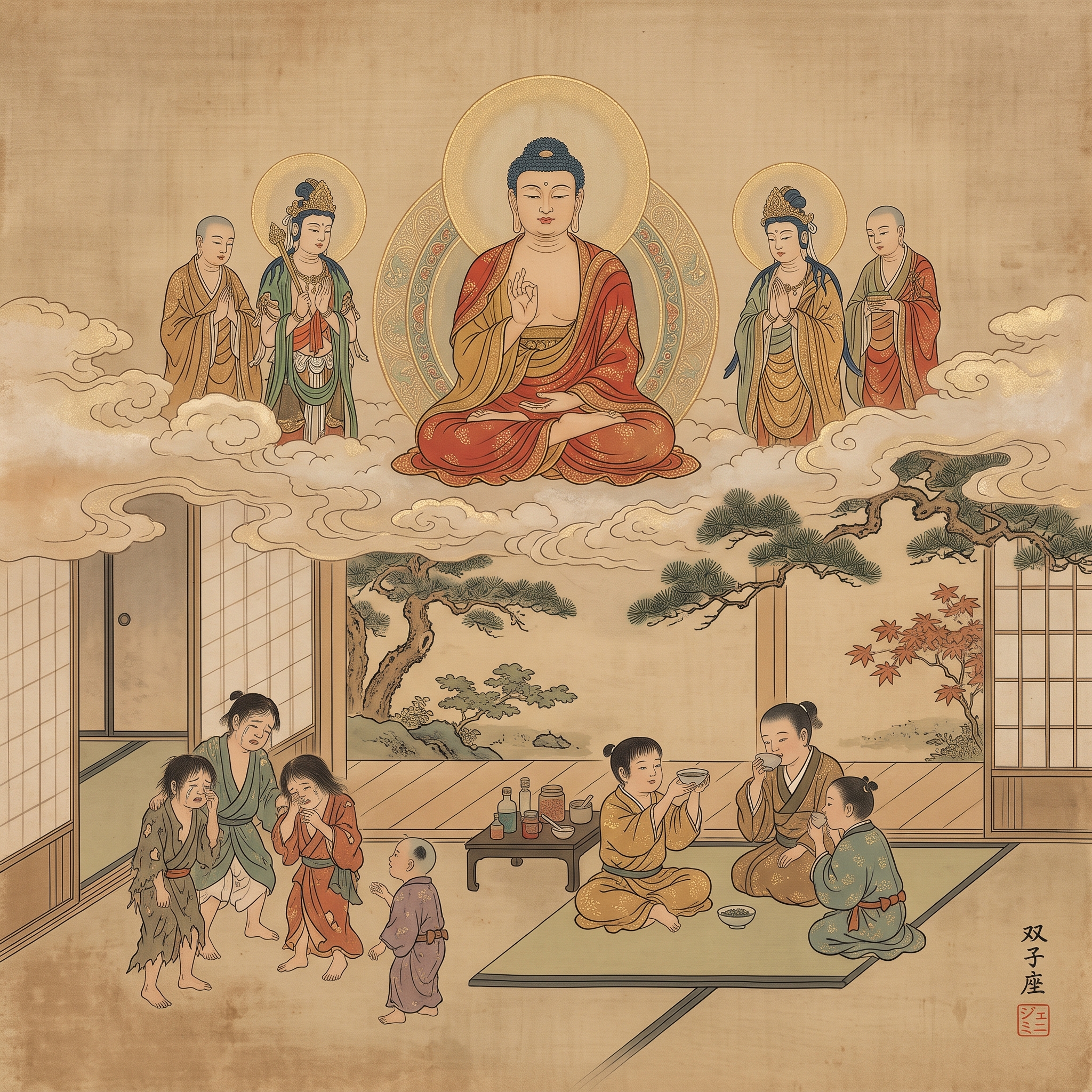
The illustration, created in a traditional Japanese Buddhist art style on aged silk, captures the emotional and spiritual arc of the "Parable of the Wise Physician" from Chapter Sixteen of the Lotus Sūtra. Above, Śākyamuni Buddha (Shaka Nyorai) appears in a compassionate, heavenly tier, symbolizing his ultimate guidance and presence even when he appears to be absent. He is surrounded by bodhisattvas and monks, set apart by gold leaf halos and floating clouds to distinguish the celestial realm from the earthly realm below. Below, the earthly narrative is illustrated within a traditional Japanese dwelling. On the left, disheveled children are shown in distress and grief, embodying their initial loneliness and helplessness. Transitioning to the right, other children have "recovered their right minds," gratefully receiving and consuming the healing medicine provided by their father, representing their awakening to his teachings. The earthly suffering and subsequent enlightenment are framed by natural elements like pine and maple trees, using mineral pigments and ink to unify the narrative of sorrow, realization, and cure under the Buddha’s overarching wisdom.
Iconography & Character Identification
Item 1: Deities/Figures Featured:
Śākyamuni Buddha (Shaka Nyorai): Sated in the center upper portion on a lotus, with the vitarka and dhyana mudra, representing the compassionate, wise father and teacher. (He is strictly distinct from Amida or Dainichi Nyorai).
Attendant Bodhisattvas and Disciples: Flanking the Buddha, representing his entourage who help transmit the Dharma and watch over sentient beings.
The "Wise Physician’s" Children:
Distressed/Grieving Children (bottom left): Shown weeping and in disarray, representing the poison-taken state, feeling "parentless and shelterless."
Healing/Recovered Children (bottom right): Shown seated on the tatami veranda, drinking the herbal medicine (antidote), representing their recovery of their "right minds" and acceptance of the Buddha's cure.
Item 2: Text Translations:
双子座: Gemini (Kanji signature, meaning "The Gemini Constellation")
ジェミニ (inside the red square seal/hanko): Gemini (Katakana translation of "Gemini")
They felt lonely and helpless because they thought that they were parentless and shelterless. Their constant sadness finally caused them to recover their right minds. They realized that the medicine had a good color, smell and taste. They took it and were completely cured of the poison.
The Buddha explains his parable of the wise physician in Chapter Sixteen of the Lotus Sūtra. In the story, the physician’s children take poison by mistake. Some refuse the antidote provided by their father until he leaves home and sends word back that he has died. The children realized that they had to accept what their father had left for them, rather than continuing to refuse his cure. In the Lotus Sūtra the Buddha stops adapting to our minds and brings us into his mind. It is only when we use our suffering to increase our determination to reach enlightenment, rather than as an indicator of our shortcomings, can we recover our right minds and realize what the Buddha teaches.
The Daily Dharma is produced by the Lexington Nichiren Buddhist Community. To subscribe to the daily emails, visit zenzaizenzai.com
Grand Master Miao-lê further interprets this in his Annotations on the Words and Phrases of the Lotus Sūtra, “Those who misunderstand the Lotus Sūtra are convinced that the practicer of the sūtra in the advanced stages gains more merit and looks down on the practicing novice of the Lotus Sūtra, without knowing the great merit of beginning practicers of the Lotus Sūtra. Grand Master T’ien-t’ai, therefore, showed that even though the beginners have not practiced the Lotus Sūtra long enough, their merit is so deep that it can reveal the strength of the sūtra.” This statement of Grand Master Miao-lê describes the ignorant people in the Latter Age of Degeneration who praise the Lotus Sūtra but consider their own capacity inadequate to understand it saying, “It is true that the Lotus Sūtra expounds so profound a doctrine that it is not suitable for us ignorant people.”
Ichidai Shōgyō Tai-I, Outline of All the Holy Teachings of the Buddha, Writings of Nichiren Shōnin,
Doctrine 3, Page 77
Conceptual Summary
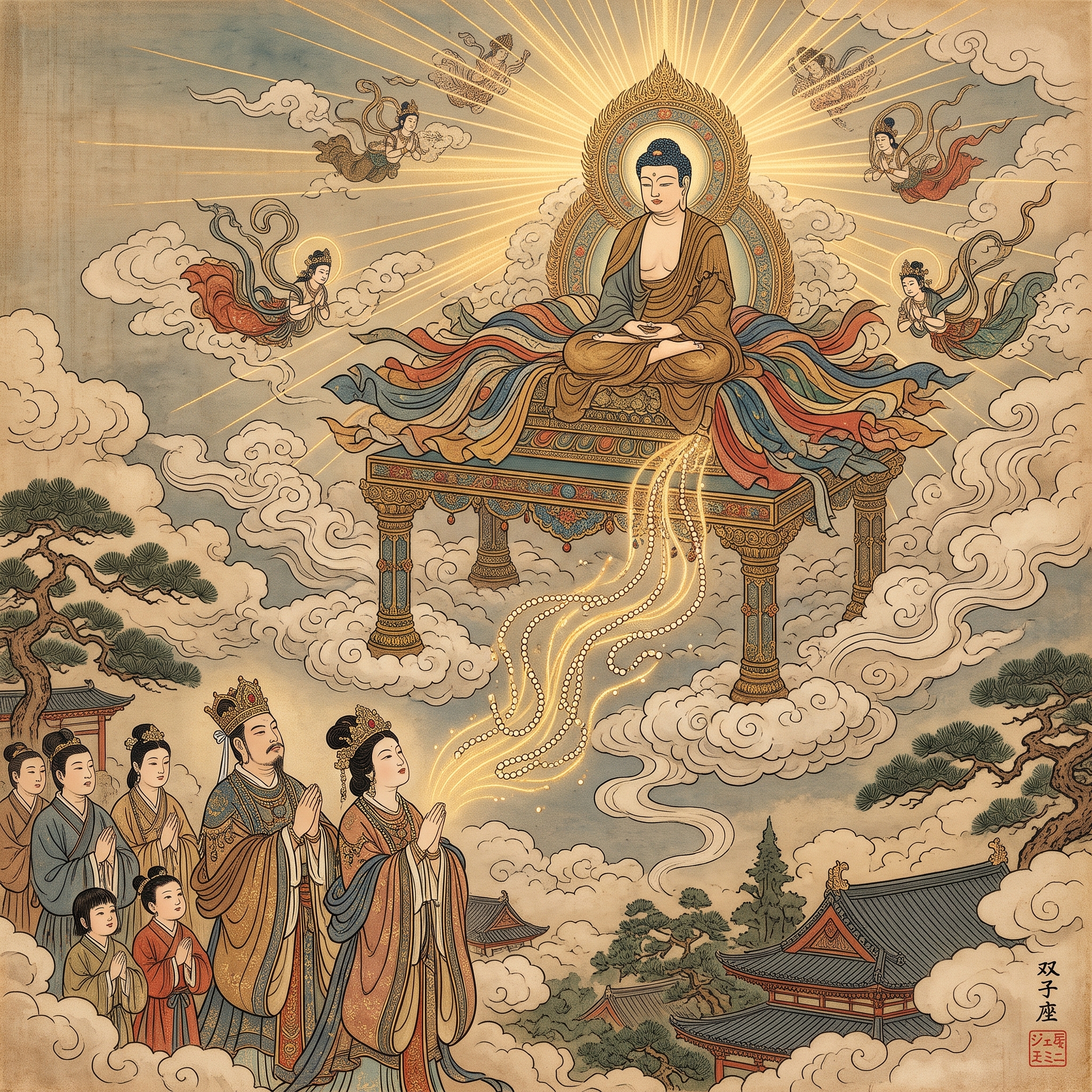
This classical Japanese Buddhist silk painting illustrates the transformative devotion from Chapter Twenty-Seven of the Lotus Sūtra, capturing the moment when earthly wealth is transmuted into a vehicle for the Dharma. In the lower foreground, King Wonderful-Adornment and his Queen stand in reverent gassho, flanked by their two young sons—whose spiritual attainment catalyzed the royal couple's awakening—and royal attendants. Luminous strands of pearls ascend directly from the rulers' hands, visually bridging the mundane realm with the sacred sky as they materialize into an ornate, four-pillared jeweled platform. Upon this elevated dais, draped in cascading, multi-colored heavenly garments, sits Cloud-Thunderpeal-Star-King-Flower-Wisdom Buddha. Rendered with golden radiance and an aura of outshining brilliance, the Buddha's serene form embodies how the transcendent beauty of awakened wisdom far eclipses the material splendor offered at his feet.
Iconography & Character Identification
Item 1: Deities/Figures Featured:
Cloud-Thunderpeal-Star-King-Flower-Wisdom Buddha (Unraionjōōkachi Nyorai): Seated cross-legged at the apex of the four-pillared jeweled platform upon layers of heavenly garments, emitting golden rays of light.
King Wonderful-Adornment (Myōshōgon-ō) and Queen Pure-Virtue (Jōtoku-bunin): Standing prominently in the lower left foreground in ornate royal attire and crowns, offering their pearl necklaces in devotion.
Prince Pure-Storehouse (Jōzō) and Prince Pure-Eye (Jōgen): The two young royal sons standing just in front of the King, hands pressed together in prayer.
Royal Attendants: Three court figures standing behind the King and princes in reverent contemplation.
Apsaras (Tennin): Four celestial beings floating amidst the upper clouds with flowing scarves, celebrating the miraculous manifestation.
Item 2: Text Translations:
Kanji Signature (双子座): "Gemini" (literally "Twins Constellation").
Red Square Seal / Hanko (ジェミニ): "Gemini" (phonetic transliteration in Katakana).
The king and queen took off their necklaces of pearls worth hundreds of thousands, and strewed the necklaces to the Buddha. The necklaces flew up to the sky [seven times as high as the tāla-tree], and changed into a jeweled platform equipped with four pillars. On the platform was a couch of great treasures, and thousands of millions of heavenly garments were spread [on the couch]. The Buddha [went up,] sat cross-legged [on the couch], and emitted great rays of light. King Wonderful-Adornment thought, ‘The Buddha is exceptional. He is exceedingly handsome. He has the most wonderful form.’
The Buddha uses this description as part of the story of King Wonderful-Adornment in Chapter Twenty-Seven of the Lotus Sūtra. This King was led by the supernatural powers of his children to meet Cloud-Thunderpeal-Star- King Flower-Wisdom Buddha who was teaching the Wonderful Dharma in that world. The King and his wife the Queen were both so inspired by that Buddha that they allowed the symbols of their wealth and power to be transformed into a sacred platform from which the Buddha could lead all beings to enlightenment. When they found that Buddha, the beauty of his wisdom far outshone the beauty of their jewels.
The Daily Dharma is produced by the Lexington Nichiren Buddhist Community. To subscribe to the daily emails, visit zenzaizenzai.com
Nobody believes in me, Nichiren, who is saying that it was Grand Master Dengyō alone who read the Lotus Sūtra correctly some 700 years after the introduction of Buddhism to Japan. It is stated, however, in the Lotus Sūtra: “It is not difficult to grab Mt. Sumeru, the highest peak in the world, and throw it over to any of those numerous Buddha lands, but is difficult to preach this Lotus Sūtra in this decadent world after the death of the Buddha.” My stubborn insistence is matched by the sūtra.
Kaimoku-shō, Open Your Eyes to the Lotus Teaching, Writings of Nichiren Shōnin, Doctrine 2, Page 43
Conceptual Summary
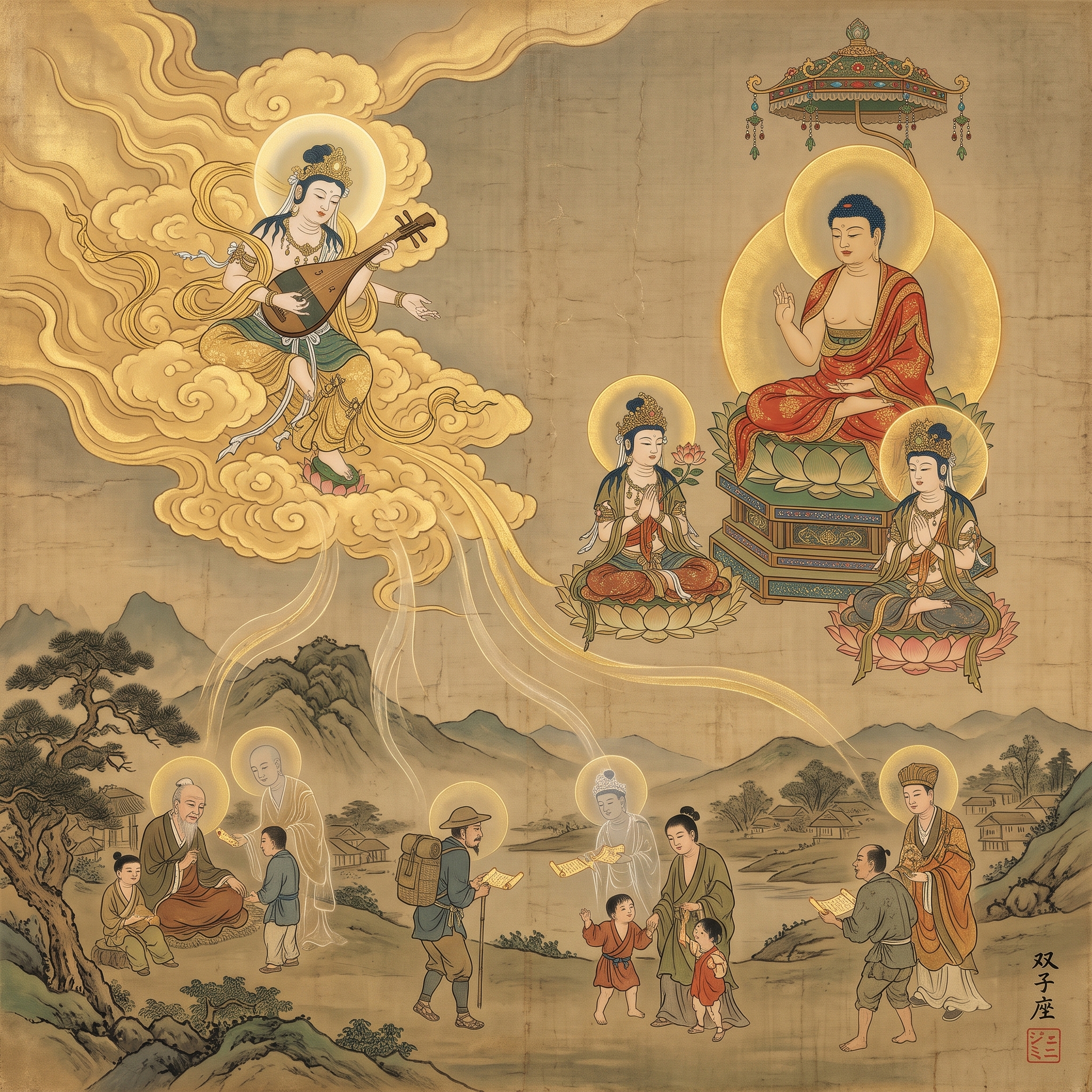
This classical Japanese Buddhist silk painting visualizes Chapter Twenty-Four of the Lotus Sūtra, bridging the celestial realm and the earthly Sahā-world. In the upper right, Śākyamuni Buddha expounds the Dharma to Flower-Virtue Bodhisattva (Ketoku Bosatsu) beneath a jeweled canopy, while Wonderful-Voice Bodhisattva (Myōon Bosatsu) descends on golden clouds to the left, playing a lute (biwa) that represents the resonant melody of the teachings. From these clouds, luminous streams of wisdom flow down into the mortal world below, manifesting as diverse, everyday figures—an elderly teacher, a wandering stranger, a gentle child, and a monastic guide. Haloed and accompanied by translucent spiritual forms, these earthly manifestations illustrate the profound truth that bodhisattvas take on whatever form is needed to awaken living beings, inviting us to recognize every person we encounter as an embodiment of enlightened compassion.
Iconography & Character Identification
Item 1: Deities/Figures Featured:
Śākyamuni Buddha (Shaka Nyorai): Seated on the elevated lotus throne in the upper right beneath a jeweled canopy, displaying the vitarka mudrā (gesture of teaching and discussion) with his right hand.
Flower-Virtue Bodhisattva (Ketoku Bosatsu): Seated on a lotus pedestal to the left of Śākyamuni Buddha, holding a lotus blossom and listening to the teaching.
Attendant Bodhisattva: Seated on a lotus pedestal to the right of Śākyamuni Buddha with hands joined in añjali mudrā (prayer/reverence).
Wonderful-Voice Bodhisattva (Myōon Bosatsu): Floating on golden clouds in the upper left, holding a traditional biwa (lute) symbolizing the "Wonderful Voice" of the Dharma echoing across the worlds.
Earthly Manifestations in the Sahā-World (Lower Register): Various figures illuminated by subtle haloes and accompanied by ethereal, translucent bodhisattva forms—including an elderly teacher instructing students, a wandering traveler/stranger with a backpack and scroll, young children interacting with their mother, and a monastic teacher guiding a layperson.
Item 2: Text Translations:
双子座 (Futagoza): "Gemini" (literally, the constellation of the Twins), rendered in traditional vertical Kanji calligraphy in the lower right corner.
ジェミニ (Jemini): "Gemini," written in Katakana characters inside the red square artist's seal (hanko) directly beneath the Kanji signature.
Flower-Virtue! This Wonderful-Voice Bodhisattva protects all living beings in this Sahā-World. He transforms himself into one or another of these various living beings in this Sahā-World and expounds this sūtra to all living beings without reducing his supernatural powers, [his power of] transformation, and his wisdom.
The Buddha gives this explanation to Flower-Virtue Bodhisattva in Chapter Twenty-Four of the Lotus Sūtra. Like many of the Bodhisattvas, Wonderful-Voice takes on the form of countless beings to reach those whom he has vowed to lead to enlightenment. For those who can be reached by a teacher, he becomes a teacher. For those who can be reached by a child, he becomes a child. For those who can be reached by a stranger, he becomes a stranger. Understanding the innumerable forms the Bodhisattvas take on to help us, we can ask: Who in this world of conflict and suffering is not a Bodhisattva? From whom can we not learn how to see things for what they are?
The Daily Dharma is produced by the Lexington Nichiren Buddhist Community. To subscribe to the daily emails, visit zenzaizenzai.com
Although the Buddhas and gods protect women who uphold the Lotus Sūtra, when their faith is weak, it seems likely they will be forsaken. For instance, when the commander-in-chief is a coward, his men are in low spirits. When a bow is weak, a bowstring becomes loose. When the wind is light, the wave is small. This is only natural.
However, Lord Shijō is a firm believer in the Lotus Sūtra, and no one among the lay people in Japan is equal to him. You, who are married to such a man, are the foremost woman in Japan. The Buddha must think of you as the dragon girl who attained Buddhahood owing to the Lotus Sūtra. The Chinese character for “wife” is read as “lean on.” Just as a wisteria plant hangs on a pine tree, a woman depends on her husband. You should rely on Lord Shijō as your teacher and have him guide you in your faith in the Lotus Sūtra.
Shijō Kingo-dono Nyōbō Gohenji, A Reply to the Wife of Lord Shijō Kingo, Writings of Nichiren Shōnin, Volume 7, Followers II, Page 122
Conceptual Summary
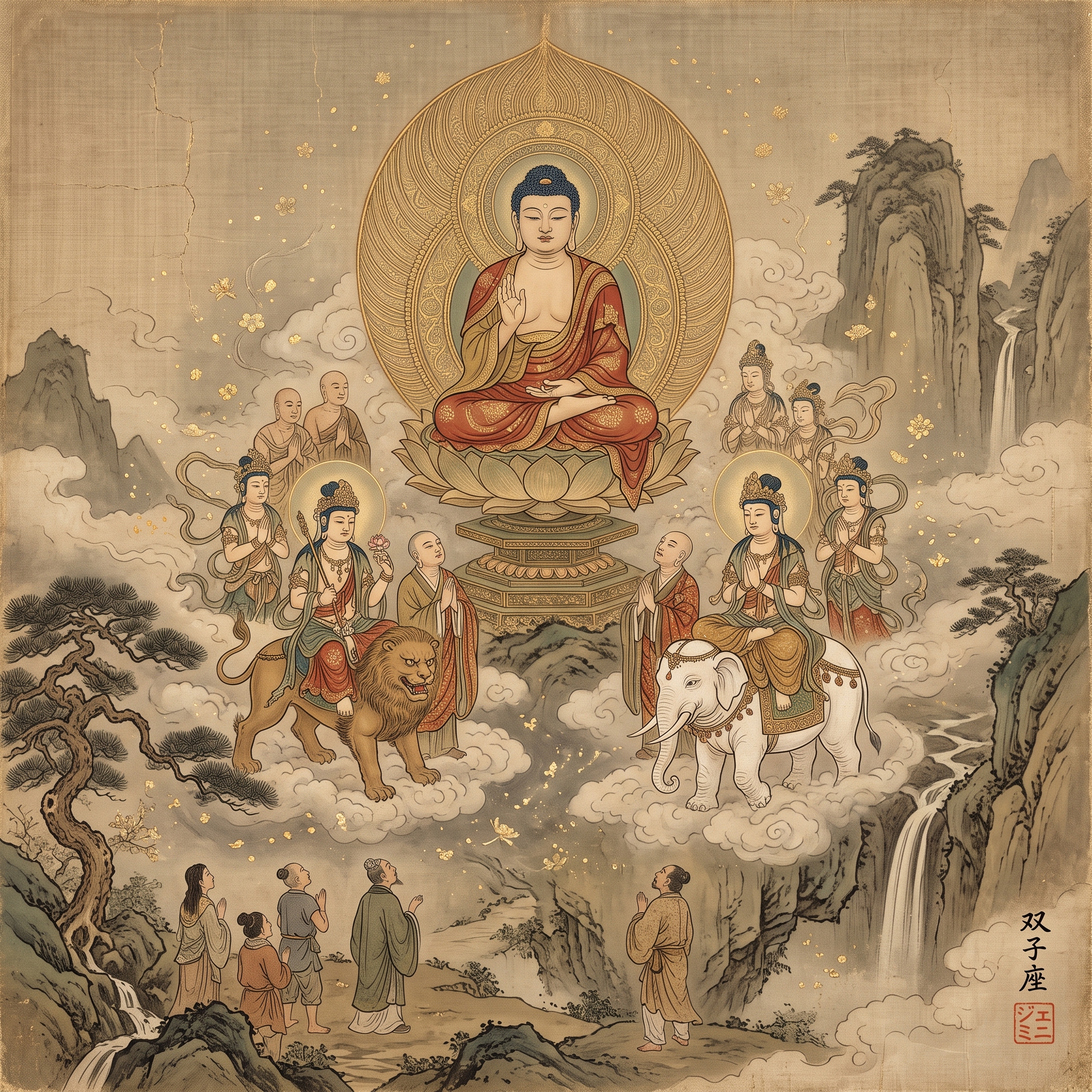
This classical Japanese Buddhist silk painting visualizes the eternal, ubiquitous nature of Śākyamuni Buddha and the Dharma as described in the Lotus Sūtra. Rather than depicting the Buddha as a distant, inaccessible figure, the composition uses luminous, swirling clouds and drifting golden lotus petals to represent the invisible, life-sustaining "air" of the Dharma that continuously permeates the world. Elevated at the center on a lotus pedestal over Vulture Peak, Śākyamuni expounds the teaching, yet his golden radiance blends seamlessly into the surrounding mist and mountain air. Below, ordinary laypeople stand amidst the earthly landscape gazing upward in sudden recognition, illustrating the moment when beings awaken from taking the world for granted and perceive the ever-present spiritual reality that has surrounded them all along.
Iconography & Character Identification
Item 1: Deities/Figures Featured:
Śākyamuni Buddha (Shaka Nyorai): Seated at the upper center on an ornate lotus throne, framed by a golden mandorla, with his right hand raised in the Abhaya Mudra (gesture of fearlessness and protection) and his left hand resting in his lap.
Mañjuśrī Bodhisattva (Monju Bosatsu): Seated on the left upon a roaring lion, holding a lotus blossom and a staff/sword representing transcendent wisdom.
Samantabhadra Bodhisattva (Fugen Bosatsu): Seated on the right upon a six-tusked white elephant with hands joined in añjali mudrā (prayer), representing universal worthy practice.
Monastic Disciples (Arhats/Śrāvakas) and Attendant Bodhisattvas: Four shaved-headed monks (commonly representing chief disciples like Śāriputra and Maudgalyāyana) and four celestial bodhisattvas flanking the central triad in attitudes of reverence.
Earthly Laypeople: Five everyday men, women, and youths standing on the rocky foreground path at the bottom, looking up through the mist with hands joined in realization.
Item 2: Text Translations:
双子座 (Futagoza): Literally translates to the constellation "Gemini" (the Twins), rendered in traditional vertical Kanji script as the artist's signature in the lower right corner.
ジェミニ (Jemini): The phonetic transliteration of "Gemini" written in Japanese Katakana, enclosed inside the red square hanko (artist's seal) directly beneath the Kanji signature.
The Buddhas seldom appear in the worlds.
It is difficult to meet them.
Even when they do appear in the worlds,
They seldom expound the Dharma.
The Buddha proclaims these verses in Chapter Two of the Lotus Sūtra. Later in the Sūtra he explains that in reality he became enlightened far in the past and will continue to lead all beings to enlightenment far into the future. The reason the Buddhas appear so rarely is not because they conceal themselves. It is because we do not recognize them for what they are. We cannot see the air we breathe, but it is crucial for our lives. Because of this we often take it for granted, unless we are so afflicted, or the air is so poisoned that we cannot breathe. Then we are aware of it. Likewise, the Buddha Dharma is available to us all the time.
The Daily Dharma is produced by the Lexington Nichiren Buddhist Community. To subscribe to the daily emails, visit zenzaizenzai.com
The Writer, Gemini NotebookWe have seen how Nichiren Buddhism unites the inward perception of innate Buddhahood (Makoto) with the outward commitment to transform society (The Heart of Faith). To prevent this synthesis from evaporating into abstract philosophy, Nichiren established concrete, tangible instruments that anchor awakening in daily human life.
Where the Tiantai master Zhiyi set forth “three thousand realms in a single moment of life” as a theoretical principle (ri no ichinen sanzen) discerned through complex introspective meditation, Nichiren revealed “ichinen sanzen in actuality” (ji no ichinen sanzen). Grounded in the origin teaching (honmon)—the latter half of the Lotus Sutra, which reveals the eternal Śākyamuni Buddha’s constant presence in this world—Nichiren gave this reality concrete form through the Three Great Secret Dharmas (Sandai Hihō) and a revolutionary understanding of sacred language.
The Three Great Secret Dharmas (Sandai Hihō)
In the Final Dharma Age (mappō), the Buddha’s primordial enlightenment is made directly accessible to all people through three core pillars:
The Daimoku (The Invocation of the Essential Teaching):
The active vocal chanting of Namu-myōhō-renge-kyō. Drawing on the Chinese tradition of title exegesis, Nichiren taught that the five or seven characters of the sutra’s title are not merely the name of a text, but “the heart of the eighty thousand sacred teachings and the eye of all buddhas”. In his 1273 masterpiece Kanjin honzon shō (The Contemplation of the Mind and the Object of Worship), Nichiren wrote: “Śākyamuni’s causal practices and their resulting virtues are all contained within the five characters Myō-hō-renge-kyō. When we embrace these five characters, he will naturally transfer to us the merit of his causes and effects”. Chanting the daimoku embodies the spirit of a “single moment of belief and understanding” (ichinen shinge) and a “single moment of rejoicing” (ichinen zuiki). Moreover, through the principle of juji soku jikai (“upholding the Dharma is itself keeping the precepts”), embracing the daimoku bestows the unbreakable “Diamond Chalice Precept,” transferring the merit of all six pāramitās directly to the practitioner.
The Honzon (The Object of Devotion):
The calligraphic mandala (daimandara or gohonzon) devised and inscribed by Nichiren. Rather than depicting anthropometric statues of individual deities, the Gohonzon uses Chinese characters and two Sanskrit glyphs to depict the cosmic ceremony in open space above Sacred Vulture Peak, where the eternal Śākyamuni Buddha and Many Treasures Buddha (Prabhūtaratna) sit flanked by the Bodhisattvas of the Earth (led by Superior Practices, or Jōgyō) and beings of all Ten Worlds. Functioning as an external mirror of the practitioner’s mind, the Gohonzon allows the devotee to “enter” the jeweled stupa of the mandala through faith and chanting, realizing the non-dual union of self and Buddha.
The Kaidan (The Sanctuary or Ordination Platform):
The physical space where the practitioner chants the daimoku before the Honzon. Doctrinally linked to works such as the Sandai hihō shō (“On the Three Great Secret Dharmas”), the kaidan carries both an institutional and an immediate, personal dimension. As Jacqueline Stone’s scholarship illustrates, the institutional concept of the kaidan underwent a dramatic evolution across history:
Medieval Vision: Understood as an ordination platform to be established “by imperial edict and shogunal decree” when secular law (ōbō) and Buddha-Dharma (buppō) unite (ōbutsu myōgō).
Imperial Nationalism: Reinterpreted by Chigaku Tanaka in the Meiji/Taishō eras as a state-mandated “national ordination platform” (kokuritsu kaidan) to be approved by the Imperial Diet.
Postwar Democracy: Reframed by Jōsei Toda as a democratic mandate, and subsequently redefined by Daisaku Ikeda in 1970 as minshūritsu (“established by the people”), culminating in the construction of the Shō Hondō at Taisekiji in 1972. Following the 1991 schism between Nichiren Shōshū and the Sōka Gakkai, Chief Abbot Abe Nikken demolished the Shō Hondō in 1998, returning the institutional kaidan to an indefinite future.
Immediate Living Practice: Beyond institutional politics, the kaidan holds a profound, universal meaning inside the Nichiren tradition: wherever a practitioner faces the Gohonzon with sincere faith and chants Namu-myōhō-renge-kyō, that very place transforms immediately into the fundamental ordination platform and the Pure Land of Eagle Peak.
Language as Sacred Embodiment
What gives written calligraphy and vocal sound the power to transform reality? In his treatise Mokue nizō kaigen no koto (“On Consecrating Wooden and Painted Images”), Nichiren articulates a remarkable philosophy of language rooted in shiki shin funi—the non-duality of physical form (shiki) and mental phenomena (shin).
While internal intention belongs to the domain of mind, vocal sound and written words belong to the domain of form. Because form directly manifests mind, the written characters of the Lotus Sutra are not dead ink on paper; they are the living embodiment of the Buddha’s “pure, far-reaching voice” (bonnonjō / brahmasvara), which conveys the Buddha’s awakened mind. This insight underpins three key dimensions of Nichiren’s ritual thought:
Consecrating Images (Kaigen Kuyō): A carved wooden or painted image of the Buddha possesses thirty-one of the Buddha’s thirty-two physical marks, lacking only the thirty-second: the pure, far-reaching voice that expresses mind. Nichiren critiqued esoteric (Shingon) eye-opening rituals that relied on mantras of Mahāvairocana (Dainichi), arguing that because they fail to instill the eternal Buddha’s voice, they leave the statue an inert block of wood—a “masterless house” (nushi naki ie) easily occupied by delusive forces. Placing the Lotus Sutra before an image, however, endows it with the Buddha’s voice and mind, turning lifeless matter into the living Buddha.
The Buddhahood of Grasses and Trees (Sōmoku Jōbutsu): Because insentient nature—including the trees and plants used to make wooden statues and paper scrolls—is fully encompassed within the three thousand realms (ichinen sanzen), consecrating them with the Lotus Sutra awakens the innate Buddha-nature of the physical world itself.
Postmortem Buddhahood (Sokushin Jōbutsu): When the words of the Lotus Sutra are chanted over the physical remains of the deceased (hone no tamashii to naseba), the non-duality of body and mind transforms the physical remains into the Dharma body (hosshin), enabling the practitioner to realize Buddhahood with this very body even in death and continue dwelling in the eternal presence of the Buddha on Eagle Peak.
Synthesizing the Path: A Unified Living Practice
When we step back and view all three parts of our exploration together, the grand architecture of Nichiren Buddhism comes into sharp focus. Practice is built upon two inseparable pillars embodied through the Three Great Secret Dharmas:
The Inward Pillar (Makoto): Continuously polishing the mirror of the mind through chanting Namu-myōhō-renge-kyō, dispelling innate ignorance (mumyō), and recognizing that our own life at this very moment encompasses all three thousand realms (ichinen sanzen).
The Outward Pillar (The Heart of Faith): Expressing that inner awakening in the physical world by upholding the Gohonzon, refuting error (shakubuku), and purifying our society and environment (kokudo seken) through compassionate engagement.
Personal enlightenment and social responsibility are never two separate tracks. They are the simultaneous internal and external expressions of the Middle Way (chūdō). By chanting Namu-myōhō-renge-kyō with sincere faith, we shatter the illusion of separation between self and Buddha, mind and land, converting our ordinary daily lives into an enduring realm of wisdom, peace, and light.
QUESTION: Why are the omens after the passing of the Buddha superior to those that occurred during His lifetime?
ANSWER: As stated earlier, an earth’s tremor is caused by the shaking of the six sense organs of human beings. Moreover, the degree of the earth’s tremor in six different ways is determined by how the six sense organs of human beings shake. In the pre-Lotus sūtras, although it appears that the evil passions of all living beings were eliminated, in actuality they were not entirely. In the Lotus Sūtra, however, they are all completely eliminated, including the fundamental darkness of mind. As a result, there was severe trembling of the earth in the Lotus Sūtra. In the Latter Age of Degeneration there exist far more evil persons than in the lifetime of the Buddha, and the Lotus Sūtra destroys the fundamental ignorance of the people in the Latter Age of Degeneration. This is the reason why the omens superior to those in the lifetime of the Buddha are manifested in the Lotus Sūtra.
Zuisō Gosho, Writing on Omens, Writings of Nichiren Shōnin, Volume 6, Followers I, Page 126



 Learn More About This Topic